Three Years After the White Paper Protests: Uyghur Student Freed, but the Filmmaker Who Documented Them Remains in Prison
Issue: Freedom of Expression
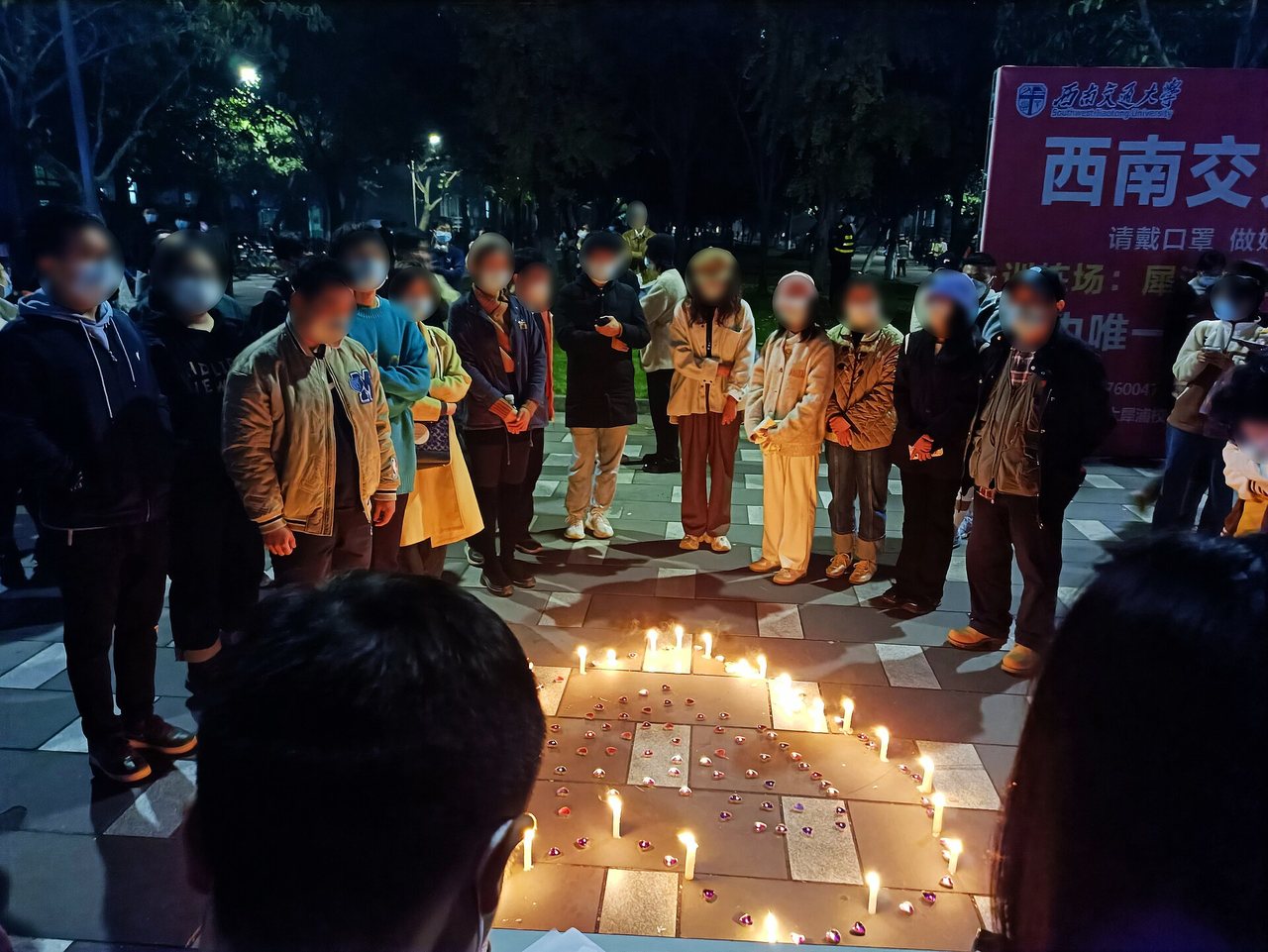
In November 2022, students at Southwest Jiaotong University in Chengdu light candles on campus to mourn the victims of the Urumqi fire. Photo: Date20221127 / Wikimedia Commons, CC0.

On December 28, 2025, Uyghur university student Kamile Wayit completed a three-year prison sentence and was released, reuniting with her family. Her entire "crime" was sharing a video of the White Paper protests on WeChat. She is one of the very few people known to have been convicted over the movement. Three years on, the protests are long over, but the bill is still being paid: Chen Pinlin, the Shanghai filmmaker who documented the movement, remains in prison, and many participants still live under surveillance, summonses and retaliation.
On November 24, 2022, a fire broke out in a high-rise residential building in Urumqi, Xinjiang; officials said 10 people died. Under the harsh "dynamic zero-COVID" lockdown regime, many suspected that lockdown measures had delayed the rescue. The next day, Urumqi residents took to the streets in protest. On November 26, students at the Communication University of China, Nanjing, were among the first to hold up blank sheets of paper and light candles on campus in mourning. That night and into the early hours of November 27, Shanghai residents gathered on the city's Urumqi Middle Road to mourn the dead and protest zero-COVID; some in the crowd chanted slogans demanding that the country's leader step down.
On November 27, hundreds gathered along Beijing's Liangma River, while crowds also appeared on Chengdu's Wangping Street and in Wuhan, Guangzhou and Xi'an; students at Tsinghua University and other campuses held up blank paper. Within days the protests had spread to dozens of cities and more than a hundred universities nationwide, and were widely seen as the largest wave of public protest in China since 1989. A blank sheet of A4 paper became the movement's symbol — blank precisely because nothing could be written on it; it pointed, silently, at censorship itself.
Ten days after the protests erupted, policy abruptly reversed. On December 7, the State Council issued the "New Ten Measures," sharply easing testing, quarantine and lockdown requirements, and the zero-COVID policy pursued for nearly three years collapsed within weeks. Observers widely regard the White Paper protests as one of the direct pressures that forced the authorities to abandon zero-COVID.
Once the streets quieted, the reckoning began: participants across the country were summoned and detained, mostly on charges of "picking quarrels and provoking trouble." Four young women who had attended the Beijing Liangma River vigil — Peking University Press editor Cao Zhixin, writer Li Siqi, accountant Li Yuanjing and teacher Zhai Dengrui — were summoned for questioning on November 29, had their phones confiscated, and were released, only to be criminally detained one by one between December 18 and 23. Sensing what was coming, Cao Zhixin had recorded a video in advance and entrusted it to friends; after she was taken away, they released it on January 16, 2023 — in it, she says she was an ordinary citizen who had simply gone to mourn. On January 19, the four were formally arrested, facing up to ten years in prison; PEN International, the European Union and others called for their release. On April 19, 2023, Cao Zhixin and Zhai Dengrui were released on bail after nearly four months in custody, and Li Siqi and Li Yuanjing were also bailed during April. No public report of any indictment or trial of the four has emerged since.
Among those known to have been sentenced, Kamile Wayit's "offence" was the slightest: a 19-year-old preschool-education student at the Shangqiu Institute of Technology in Henan, she shared on WeChat in November 2022 a video mourning the Urumqi fire and protesting the lockdowns. On December 12, after she returned to her hometown of Atush in Xinjiang, police took her away. On March 25, 2023, she was sentenced to three years in prison for "promoting extremism." Amnesty International has noted that she is one of the very few people known to have been convicted over the White Paper protests, and that the severity of her treatment is inseparable from her Uyghur identity. On December 28, 2025, she completed her sentence and was released.
Another person still not free is Chen Pinlin (online name Plato), an independent documentary filmmaker in Shanghai. On November 26, 2023, the first anniversary of the movement, he released Urumqi Middle Road, a documentary edited from footage shot by participants, on overseas platforms; two days later Shanghai police took him away. On January 6, 2025, the Baoshan District People's Court in Shanghai tried his case behind closed doors and sentenced him to three years and six months for "picking quarrels and provoking trouble," with his term running to May 2027. Reporters Without Borders and the Committee to Protect Journalists have condemned the sentence and demanded his release — his crime, in the end, was documentation.
In November 2025, on the movement's third anniversary, a reporter for Spain's El País visited the intersection of Urumqi Middle Road and Anfu Road in Shanghai and found a visibly heavier police presence and tight checks. The report quoted participants saying that over the past three years some had been confined in psychiatric hospitals, others expelled from university or stripped of their passports, and many more required to report to the police before leaving Shanghai. The movement lasted only a few days; for many ordinary participants, it has never really ended.
Sources: PEN International, Amnesty International, the Committee to Protect Journalists, Reporters Without Borders, and El País's third-anniversary report.