Ilham Tohti: Ten Years Into a Life Sentence, the EU and Rights Groups Renew Calls for His Release
Issue: Freedom of Expression
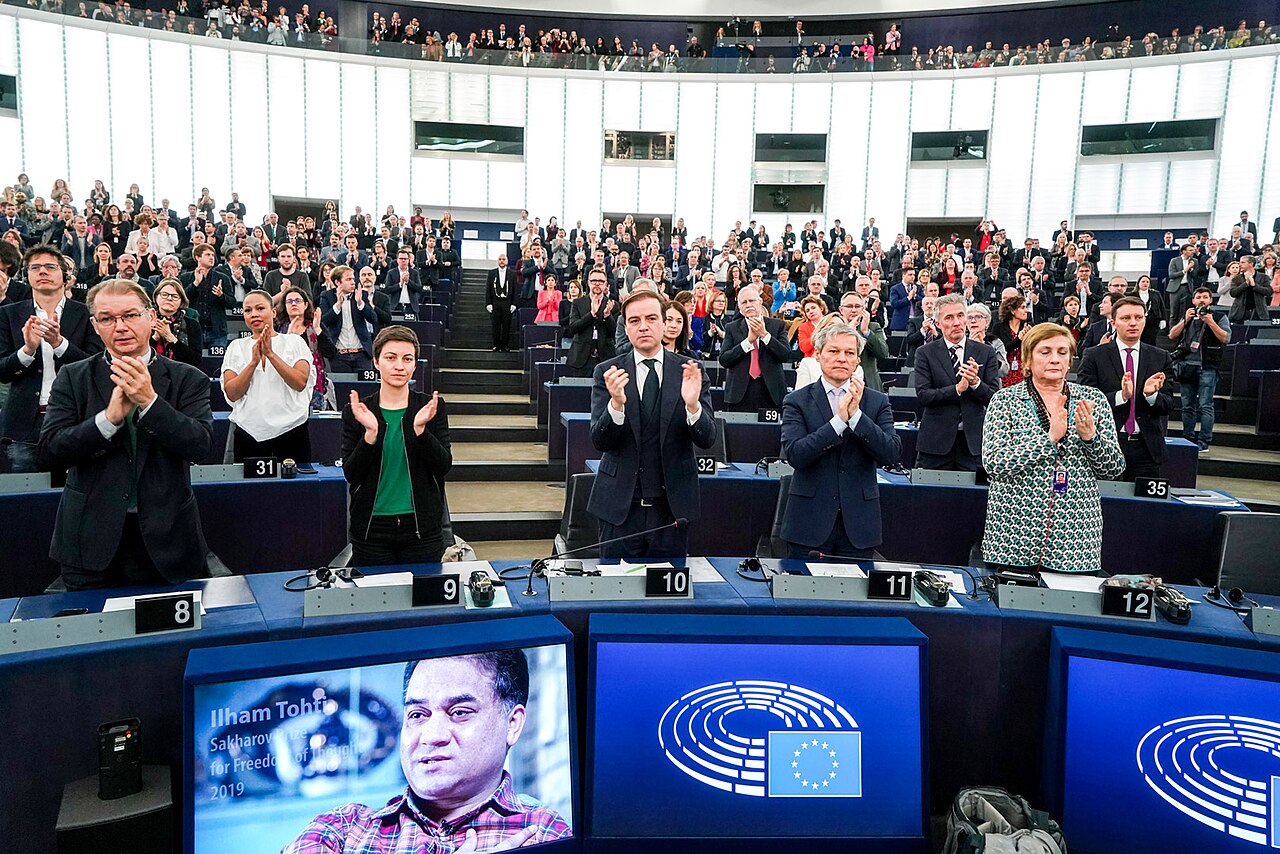
In December 2019, members of the European Parliament rise in applause in Strasbourg as the Sakharov Prize is awarded to the imprisoned Ilham Tohti, his portrait on the chamber screen; his daughter Jewher Ilham accepted the prize on his behalf. Photo: European Parliament, via Wikimedia Commons, CC BY 2.0.

September 23, 2024, marked ten years since Uyghur scholar Ilham Tohti was sentenced to life in prison. That day the European Union’s High Representative issued a statement, and Human Rights Watch and Amnesty International added their voices, all demanding his immediate and unconditional release. Tohti was jailed for criticizing ethnic policy and advocating dialogue between Uyghurs and Han Chinese; in 2019, still behind bars, he received the European Parliament’s highest human rights honour, the Sakharov Prize for Freedom of Thought.
Born in Artux, Xinjiang, in 1969, Tohti was a professor of economics at Minzu University of China in Beijing who spent more than two decades researching employment, poverty and ethnic relations in Xinjiang. He consistently argued for Uyghur rights within a united China and for dialogue to bridge the divide between communities, and was widely regarded as a moderate voice. In 2006 he founded the website Uyghur Online to give Uyghurs a platform to speak and exchange views; the site was repeatedly shut down, and he was repeatedly placed under house arrest and blocked from travelling abroad, yet he kept speaking out.
On January 15, 2014, police seized Tohti from his Beijing home; a number of his students were detained at the same time, seven of whom were later sentenced to three to eight years for “separatism.” After a two-day trial on September 17–18, the Urumqi Intermediate People’s Court sentenced him on September 23, 2014 to life imprisonment, lifelong deprivation of political rights and confiscation of all his personal property; the Xinjiang High People’s Court rejected his appeal that November. The “evidence” against him consisted mainly of his lectures, his articles, the content of his website and interviews he had given to foreign media.
Honours followed him into prison: the PEN/Barbara Goldsmith Freedom to Write Award in 2014, the Martin Ennals Award for Human Rights Defenders in 2016 and the Council of Europe’s Václav Havel Human Rights Prize in 2019. In October 2019 the European Parliament named him laureate of the Sakharov Prize; at the Strasbourg ceremony that December he could not attend, and his daughter Jewher Ilham, exiled in the United States, accepted it on his behalf. According to Human Rights Watch, he has long been held in solitary confinement, his family has been denied visits for years, and nothing is known of his health.
On the tenth anniversary of his sentencing, the EU statement called Tohti’s imprisonment emblematic of the human rights situation in Xinjiang and cited the UN human rights office’s 2022 assessment, which found serious abuses in the region that may amount to crimes against humanity. Jewher Ilham continues to campaign for her father from the United States. Ten years on, Ilham Tohti remains in prison under a life sentence, his case a benchmark by which the world measures human rights in Xinjiang.
Sources: the European External Action Service, Amnesty International and the European Parliament.