Causeway Bay Books Case: Lam Wing-kee Dies in Taipei; of the Five Booksellers, Only Gui Minhai Remains in Prison
Issue: Press Freedom · Topic: Hong Kong & Macau
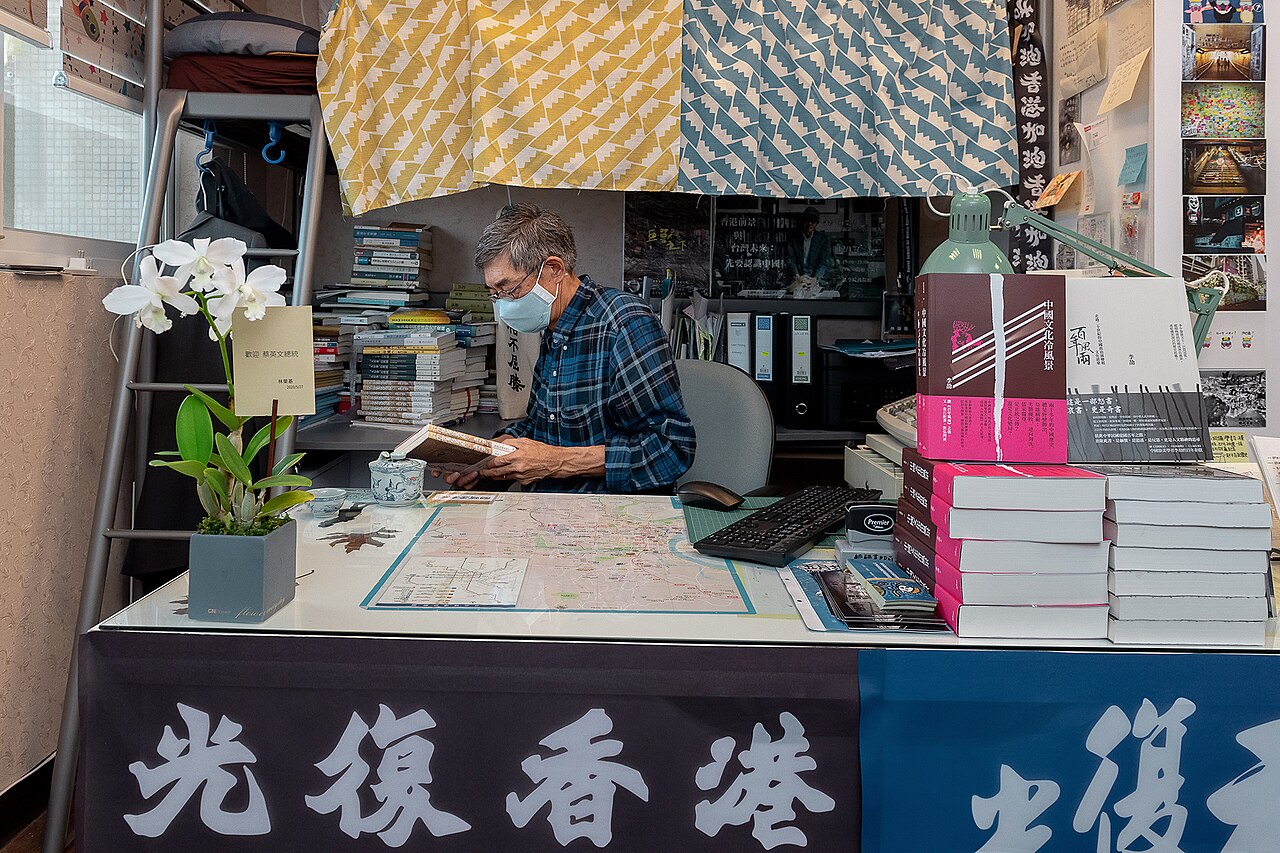
Lam Wing-kee inside the Causeway Bay Books he reopened in Taipei’s Zhongshan District, May 29, 2020. Photo: Office of the President, Taiwan / Wikimedia Commons, CC BY 2.0.

Lam Wing-kee, founder of Hong Kong’s Causeway Bay Books, died in Taipei on July 2, 2026, aged 70. In late 2015, Lam and four associates of the bookshop vanished one after another — in Thailand, on the mainland and in Hong Kong itself — in a case that became an emblem of China’s cross-border suppression of publishing and free expression. Lam was the only one of the five to speak publicly about his detention. More than a decade on, publisher Gui Minhai is the only one still behind bars in China, held at a location that has never been disclosed. Taiwan’s President Lai Ching-te paid tribute to Lam’s courage after his death.
Founded by Lam in 1994 on Lockhart Road in Causeway Bay, the bookshop specialised in political titles banned on the mainland, many of them published by Mighty Current Media, a company co-founded by Gui Minhai, and sold largely to mainland visitors. In mid-October 2015, Mighty Current’s general manager Lui Por disappeared in Shenzhen, and shareholder Cheung Chi-ping was taken from his home in Dongguan. On October 17, Gui, a Swedish citizen, was seized from his holiday apartment in Pattaya, Thailand, and heard from no more. On October 24, Lam disappeared after crossing from Hong Kong into Shenzhen. On December 30, shareholder Lee Bo vanished near a warehouse in Chai Wan, Hong Kong — his travel permit was still at home, and Hong Kong immigration had no record of him leaving. Five men from one small bookshop had been disappeared, one by one, over the space of ten weeks.
In early 2016 the five surfaced on mainland state media: Gui “confessed” on CCTV that he had returned voluntarily to surrender over a 2003 traffic case; Lam and others admitted on Phoenix TV to helping mail banned books to mainland customers. In March 2016, Lui, Cheung and Lee returned to Hong Kong, asked police to cancel their missing-person reports, then went back to the mainland and fell silent. Lam was allowed back in June 2016, ostensibly to retrieve the bookshop’s customer records. Instead of returning to the mainland as ordered, he held a press conference alongside legislator Albert Ho: he described being stopped at the Shenzhen border, blindfolded and taken by train to Ningbo, held alone in a small room under round-the-clock guard for five months, interrogated repeatedly about the book-mailing business, and made to read a scripted confession on television. He urged Hongkongers to “say no to the powerful.” It was the first detailed public account of the cross-border detentions from one of the men taken.
Gui Minhai’s ordeal was the harshest. In October 2017, China said he had completed his sentence for the traffic case and been released, but he remained under tight surveillance and was barred from leaving the country. On January 20, 2018, travelling by train to Beijing for medical treatment in the company of two Swedish diplomats, he was seized by more than a dozen plainclothes police in front of the diplomats. In February 2020, the Ningbo Intermediate People’s Court sentenced him to ten years in prison for “illegally providing intelligence to foreign entities,” saying he had “restored” his Chinese nationality; Sweden insists he remains a Swedish citizen. China has never disclosed where he is held, and has refused Swedish consular access and family visits. His daughter, Angela Gui, has campaigned for his release for years and says she has faced intimidation by Chinese state agents.
In 2019, fearing he would be handed over if Hong Kong’s proposed extradition bill passed, Lam moved to Taiwan. On April 25, 2020 he reopened Causeway Bay Books in Taipei’s Zhongshan District — days after being splashed with red paint in a nearby café — and the shop became a spiritual landmark for exiled Hongkongers and Taiwanese readers. In October 2025, ten years after the disappearances, Amnesty International, PEN International and a coalition of 90 human rights organisations renewed calls for Gui’s immediate release; the European Parliament adopted a resolution on his case, and Sweden’s foreign minister raised it in person in Beijing. Lam has now died in Taipei, never able to return to Hong Kong; Gui remains in prison, his whereabouts unknown. The case is not over.
Sources: Amnesty International, the joint statement by Fortify Rights and 90 human rights organisations, PEN International, and the Associated Press.