Liu Xiaobo: Jailed 11 Years for Charter 08, He Won the Nobel Peace Prize Behind Bars and Died in Custody
Issue: Freedom of Expression
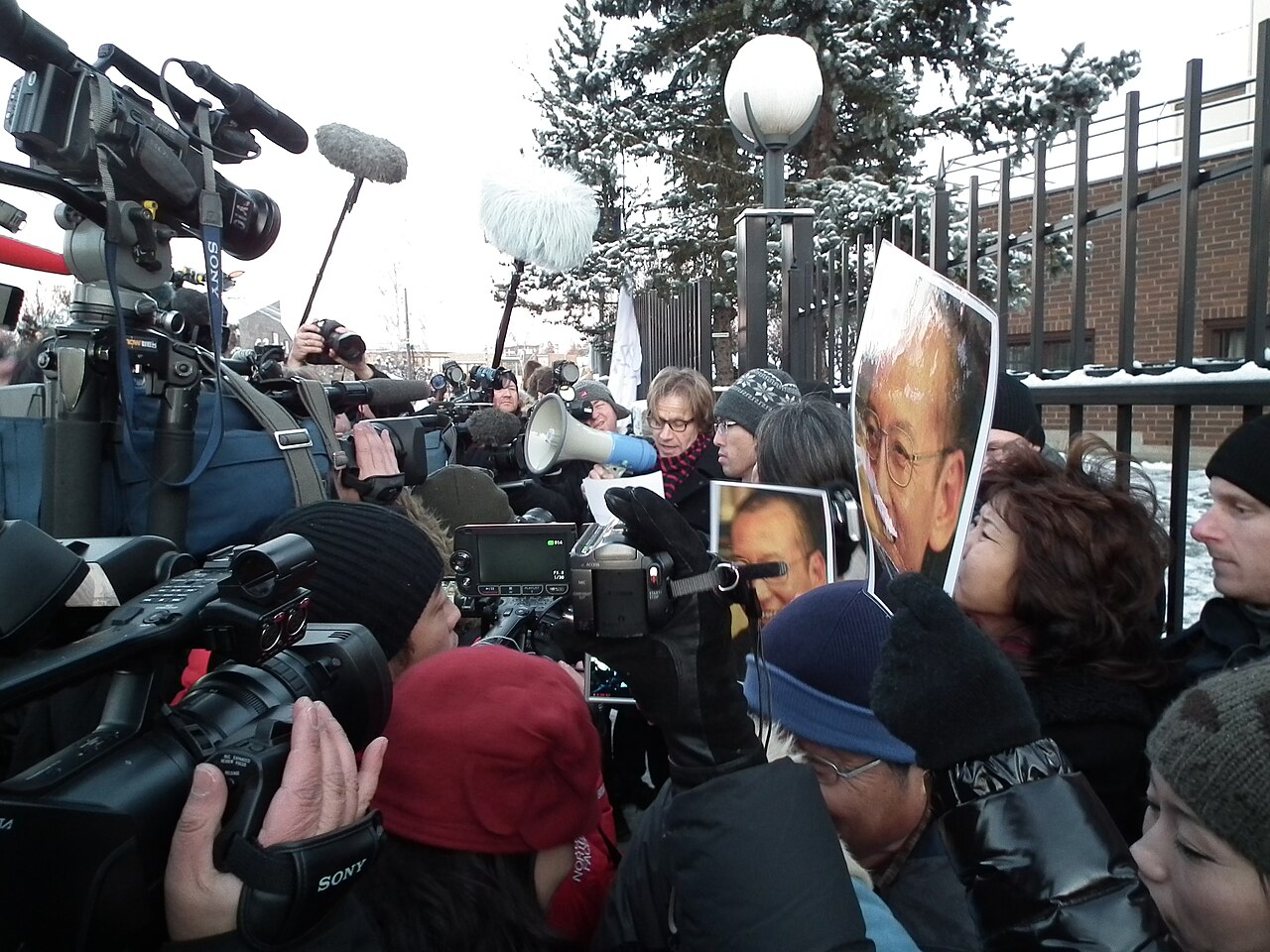
On December 9, 2010, on the eve of the Nobel Peace Prize ceremony, demonstrators outside the Chinese embassy in Oslo hold portraits of Liu Xiaobo and demand his release. Photo: Bair175, via Wikimedia Commons, CC BY-SA 4.0.

On July 13, 2017, Liu Xiaobo died at the First Hospital of China Medical University in Shenyang, aged 61. The principal author of Charter 08, he had been sentenced in 2009 to 11 years in prison for “inciting subversion of state power” and won the Nobel Peace Prize behind bars in 2010. In June 2017, diagnosed with terminal liver cancer, he was granted medical parole — but remained under tight guard and was never allowed to seek treatment abroad. He was the first Nobel Peace laureate to die in custody since Germany’s Carl von Ossietzky in 1938.
Born in Changchun in 1955, Liu was a literary critic and writer who had taught at Beijing Normal University. During the 1989 Tiananmen protests he joined a hunger strike and helped negotiate the students’ withdrawal from the square — one of the “four gentlemen” of Tiananmen — and was jailed repeatedly in the years that followed. In 2008 he helped draft Charter 08, a manifesto calling for constitutional reform, judicial independence and human rights, released on the 60th anniversary of the Universal Declaration of Human Rights with 303 initial signatories. Two days before its release, on the night of December 8, 2008, police took him from his home.
On December 25, 2009, the Beijing No. 1 Intermediate People’s Court sentenced Liu to 11 years in prison and two years’ deprivation of political rights for “inciting subversion,” resting its verdict chiefly on Charter 08 and six essays he had signed. He was sent to Jinzhou Prison in Liaoning. On October 8, 2010, the Norwegian Nobel Committee awarded him the Peace Prize “for his long and non-violent struggle for fundamental human rights in China.” At the Oslo ceremony on December 10, neither Liu nor his family was permitted to attend; his medal and diploma were placed on an empty chair — an image that became a worldwide symbol. His wife, the poet Liu Xia, was placed under house arrest as soon as the prize was announced and cut off from the outside world.
In May 2017, Liu was diagnosed in prison with late-stage liver cancer. In June he was moved to the Shenyang hospital on medical parole, his ward under constant guard. His family and governments abroad appealed for him to be treated overseas; German and American doctors who examined him judged that he could be transported, but Beijing refused to let him go. He died in the hospital on July 13. Two days later his body was cremated and his ashes scattered at sea in an official arrangement; Liu Xia vanished from contact.
Liu Xia, never charged with any offence, spent nearly eight years under house arrest and surveillance, her physical and mental health badly damaged. After sustained pressure from Germany and others, she was finally allowed to leave China on July 10, 2018, and settled in Berlin. Liu Xiaobo’s name, writings and image remain comprehensively censored inside China, and public commemorations are banned; around the world, the photograph of the empty chair and his words continue to circulate.
Sources: the Nobel Prize, Chinese Human Rights Defenders, PEN America and IFEX.