
The Li Wenliang Case: The "Whistleblower" Reprimanded by Police, Dead of COVID-19, His Reprimand Later Revoked and Honours Conferred
Issue: Free Speech
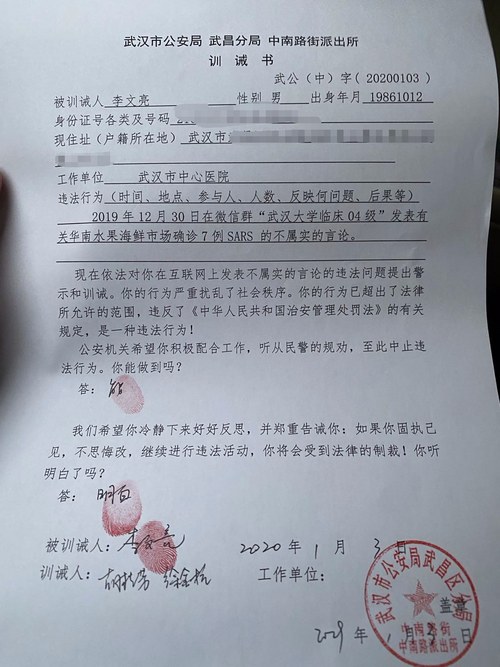
The reprimand letter Li Wenliang signed at the Zhongnan Road Police Station (Wuchang District) of the Wuhan Public Security Bureau on January 3, 2020. The reprimand letter was revoked on March 19, 2020. Image: Public domain, Wikimedia Commons.
Li Wenliang, an ophthalmologist at Wuhan Central Hospital, alerted a group chat of his university classmates on December 30, 2019, to the appearance of SARS-like cases; days later, police reprimanded him for spreading false claims. He contracted COVID-19 while treating a patient and died in the early hours of February 7, 2020, aged just 34. An investigation team from the National Supervisory Commission later found that the reprimand letter had been improper; the Wuhan Public Security Bureau revoked the reprimand and apologised, and Li Wenliang was posthumously recognised as a martyr and awarded the China Youth May Fourth Medal.
Li Wenliang was born in 1985 in Beizhen, Liaoning (according to official martyr materials), graduated in clinical medicine from Wuhan University, and worked as an ophthalmologist at Wuhan Central Hospital. On the afternoon of December 30, 2019, he forwarded a test report to a WeChat group of university classmates, saying that seven cases of SARS had been confirmed, and noting that the warning was for the classmate group only and should not be passed on; screenshots later spread widely beyond the group. On December 31, he was called in for a talk by the hospital.
On January 3, 2020, the Zhongnan Road Police Station (Wuchang District) of the Wuhan Public Security Bureau issued Li Wenliang a reprimand letter, stating that he had posted false claims in the WeChat group, such as that "seven cases of SARS have been confirmed at the Huanan Seafood Wholesale Market," seriously disturbing social order, and requiring him to heed the police and stop his illegal conduct; he signed the reprimand letter and pressed his fingerprint on it. In early January 2020, official media reported that the police had dealt with eight "rumour-mongers"; whether Li Wenliang was one of the eight was never clearly defined by the authorities — some reporting noted that the eight were dealt with on January 1, while he was not reprimanded until January 3, and he himself said while alive that he was not sure.
On January 8, Li Wenliang treated an elderly glaucoma patient who was later confirmed to be infected. Between January 10 and 12, he developed symptoms including a fever and was hospitalised. On February 1, he tested positive for COVID-19 and announced it on Weibo. In an interview with Caixin, he said: "A healthy society should not have only one voice." On the night of February 6, his condition deteriorated. The hospital announced that he had died at 2:58 a.m. on February 7. News that night was confused, with several outlets initially reporting that resuscitation was still under way; China Newsweekly reported that his heart had stopped at 9:30 p.m. on February 6, while The New York Times, citing a doctor who was present, reported that his heart had stopped at around 9:10 p.m. and that extracorporeal membrane oxygenation (ECMO) had not actually been used before midnight, having been installed at the insistence of hospital leaders to show that no effort was being spared in the rescue — these accounts stand alongside the hospital's announcement, with no settled conclusion.
On the night of Li Wenliang's death, the National Supervisory Commission announced that it was sending an investigation team to Wuhan for a full investigation. On March 19, 2020, the team issued its findings: the reprimand letter issued by the Zhongnan Road Police Station had been improper and its law-enforcement procedures irregular; the head of the investigation team answered reporters' questions on the findings. That same evening, the Wuhan Public Security Bureau revoked the reprimand letter issued to Li Wenliang and formally apologised to his family. According to a Wuhan Public Security Bureau notice (as relayed by Xinhua and others), Yang Li, the deputy director of the police station, received an admonitory talk, and officer Hu Guifang received an administrative warning.
In early March 2020, the National Health Commission and two other departments posthumously named Li Wenliang an "Advanced Individual in the National Health System's COVID-19 Prevention and Control Work." On April 2, Hubei Province recognised him as one of the first group of martyrs (fourteen people in total). On April 20, the Central Committee of the Communist Youth League and the All-China Youth Federation posthumously awarded him the 24th China Youth May Fourth Medal.
After Li Wenliang's death, his Weibo account became a lasting space of mourning, known as an online "wailing wall": over the years, large numbers of internet users have continued to leave messages on the anniversaries of his death and on pandemic-related memorial dates, and a 2026 academic study counted more than 210,000 accumulated comments on his account. On February 11, 2020, the United States Senate passed Senate Resolution 497, commemorating Li Wenliang's life and calling on the Chinese government to increase transparency of information about the epidemic; the same year, he was named to the TIME100 list of the year's most influential people.
Sources: National Supervisory Commission investigation team, report on the investigation into matters concerning Dr Li Wenliang (March 19, 2020, released with authorisation by Xinhua); Associated Press, report on the revocation of the reprimand (March 2020); NPR, report on his Weibo memorial space (February 7, 2021); United States Senate, Senate Resolution 497 (February 11, 2020); Sixth Tone, report on his online memorial (February 2020); Report on Hubei Province's first list of martyrs (April 3, 2020).