Journalist Huang Xueqin Completes Five-Year Sentence, but Friends Still Cannot Reach Her
Issue: Press Freedom
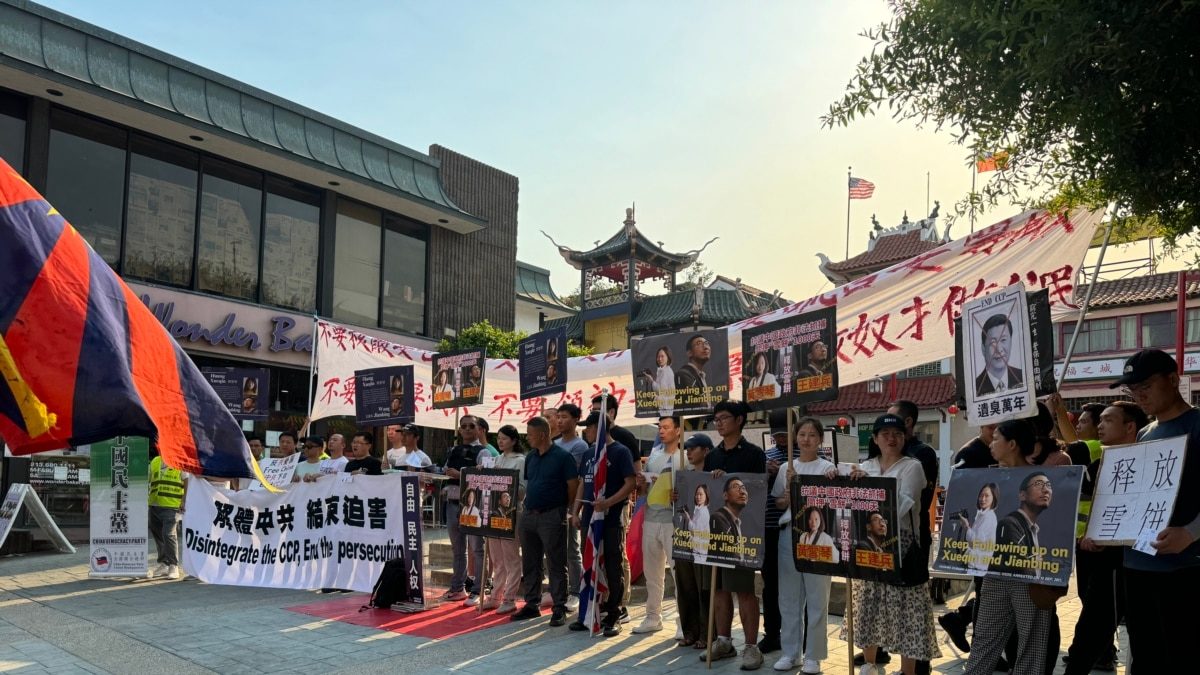
Supporters hold portraits of Huang Xueqin and Wang Jianbing at a rally in Los Angeles’ Chinatown on June 16, 2024, protesting their sentencing. Photo: Voice of America, via Wikimedia Commons, public domain.

On September 18, 2026, independent journalist Huang Xueqin completed a five-year prison sentence at Guangdong Women’s Prison. But according to The Guardian, her supporters said in a statement the next day that none of her friends had been able to reach her or learn anything about her. She also faces four years’ deprivation of political rights, running until September 2030.
Born in Shaoguan, Guangdong, in 1988, Huang worked as an investigative journalist for New Express and Southern Metropolis Weekly, reporting on gender equality and vulnerable groups. In 2018 she helped doctoral student Luo Xixi go public with sexual-harassment allegations against her supervisor, igniting China’s #MeToo movement, and she went on to support many more survivors. In October 2019, Guangzhou police detained her for three months, under the charge of “picking quarrels and provoking trouble,” over her reporting on Hong Kong’s anti-extradition protests.
On September 19, 2021, Huang and labour activist Wang Jianbing were taken away by police in Guangzhou — one day before she was due to fly to Britain on a UK government scholarship to begin a master’s degree at the University of Sussex. The two were held incommunicado for more than five months. The case against them rested in part on weekly private gatherings with friends and on their participation in and organisation of training in “non-violent movements”; supporters call it the “Xuebing” case, a blend of the pair’s nicknames. On September 22, 2023, the case was heard behind closed doors at the Guangzhou Intermediate People’s Court, with no verdict announced.
On June 14, 2024, the Guangzhou court sentenced Huang to five years in prison for “inciting subversion of state power,” plus four years’ deprivation of political rights and confiscation of 100,000 yuan in personal assets; Wang received three years and six months. In September 2024, the Guangdong High People’s Court rejected their appeals without holding a hearing and without notifying their lawyers in advance. Huang was later transferred to Guangdong Women’s Prison to serve her sentence.
According to a close friend who spoke to Reporters Without Borders (RSF), Huang spent five months in solitary confinement during her detention and was subjected to interrogation in a “tiger chair” and repeated questioning in the middle of the night; she lost a drastic amount of weight, stopped menstruating, and developed severe calcium deficiency, hypoglycaemia and low blood pressure, leaving her health badly damaged. While imprisoned, she received the International Women’s Media Foundation’s 2022 Wallis Annenberg Justice for Women Journalists Award and Index on Censorship’s 2022 Freedom of Expression Award for journalism. Wang Jianbing completed his sentence and was released in March 2025.
On the eve of Huang’s release, sixty human-rights organisations, in a joint statement led by RSF and Amnesty International, called on the Chinese authorities to guarantee her full freedom after release, without surveillance, harassment or restrictions. Yet more than two months after her term ended, as of publication, no public reporting has confirmed that she has arrived home safely or regained contact with the outside world.
Sources: The Dui Hua Foundation, Reporters Without Borders, the joint statement by Amnesty International and 59 other organisations, and reporting by The Guardian.