Guo Feixiong: Barred From Seeing His Dying Wife, Jailed a Third Time as His Health Fails in Prison
Issue: Freedom of Expression
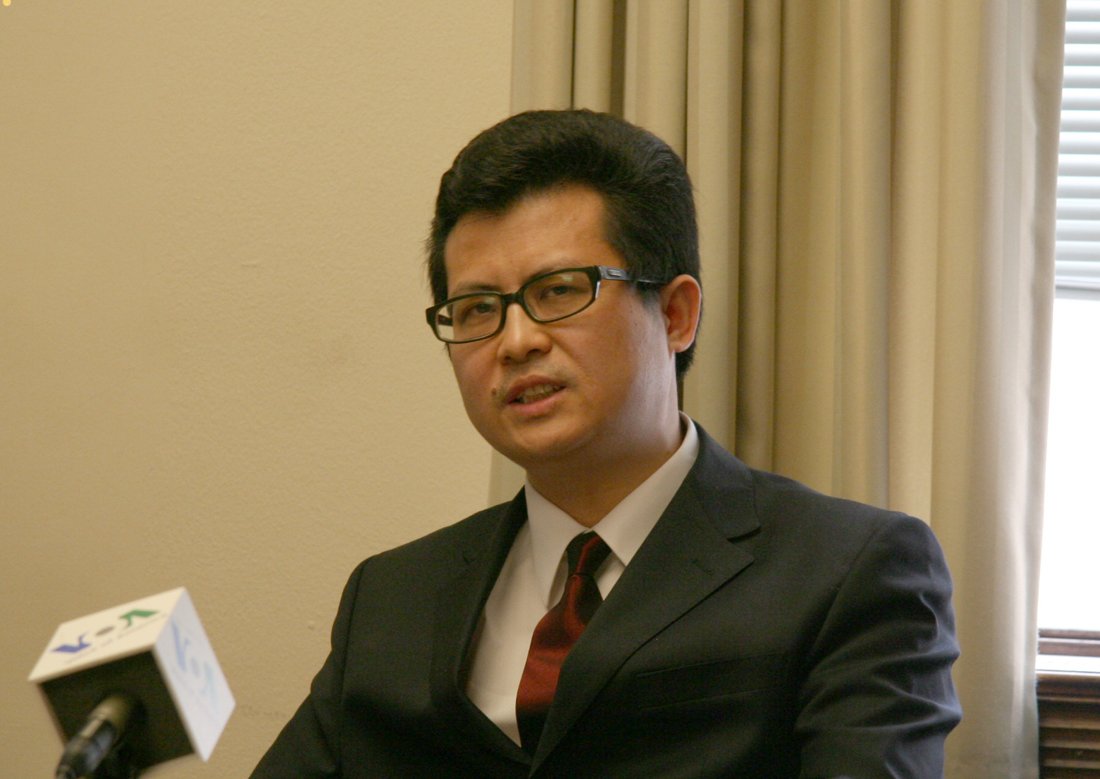
Guo Feixiong in 2013. Photo: Voice of America / Wikimedia Commons, public domain.

On October 18, 2023, Mary Lawlor, the UN Special Rapporteur on human rights defenders, said Guo Feixiong’s health had deteriorated seriously in prison and that he was in a “critical state,” adding that Chinese authorities could no longer ignore calls for his release. Human Rights Watch had reported days earlier that his hunger strike at Sihui Prison in Guangdong had cut his weight from about 70 kg to roughly 40 kg. It is his third prison term — and this time, he was not even allowed to see his dying wife one last time.
Guo Feixiong, whose real name is Yang Maodong, was born in Hebei in 1966 and graduated in philosophy from East China Normal University. A writer and rights advocate known as a “barefoot lawyer,” he took part in the 1989 pro-democracy movement. In 2005 he provided legal assistance to villagers in Taishi, Guangdong, who were trying to remove a corrupt village chief, and was beaten and detained repeatedly for his work. In 2015 he received the Front Line Defenders Award — while in prison.
Guo was arrested in September 2006 and, in November 2007, a court in Guangzhou’s Tianhe District sentenced him to five years for “illegal business operations” — over his role in publishing a book exposing a political scandal in Liaoning. He served his term at Meizhou Prison, where, his family said, he was tortured, including with electric batons; he was released in September 2011. After he joined protests outside the Southern Weekly newspaper in 2013, he was arrested again that August; in November 2015 he was sentenced to six years for “gathering a crowd to disturb public order” and “picking quarrels and provoking trouble,” the second charge added by the court itself. He was released on August 7, 2019. His three sentences add up to 19 years.
His wife, Zhang Qing, had fled to the United States with their two children via Thailand in 2009 and won political asylum; from America she campaigned for him for years, testifying before the US Congress and speaking to the media. In January 2021 she was diagnosed with terminal colon cancer. Guo wrote open letter after open letter pleading to be allowed to travel to her side. On the evening of January 28, 2021, after completing departure formalities at Shanghai Pudong Airport, border police stopped him from boarding on the grounds of “suspected endangerment of national security”; he was then kept under house surveillance with his communications restricted. In November 2021, Zhang published an open letter saying the cancer had spread throughout her body and doctors gave her one to two months to live.
On December 5, 2021, Guangzhou police took Guo away in secret; he was held incommunicado for more than six months, seeing a lawyer for the first time only in June 2022. On January 10, 2022, Zhang Qing died in a hospital in Maryland, aged 55 — the couple had been forced apart for 15 years and never saw each other again. Two days later, on January 12, Guo was formally arrested for “inciting subversion of state power.” A US State Department spokesperson called on China to let him travel to the United States on humanitarian grounds to reunite with his children and mourn his wife.
On May 11, 2023, the Guangzhou Intermediate People’s Court sentenced Guo to eight years in prison and three years’ deprivation of political rights for “inciting subversion,” over a website he had set up and articles calling for constitutional democracy. Diplomats from several countries were barred from the courtroom, his family could not attend, and the court afterwards refused to give the written judgment to his family or lawyers. On June 26, the Guangdong High Court dismissed his appeal. In July he was transferred to Sihui Prison in Zhaoqing, Guangdong, to serve his sentence.
In prison, Guo has kept up a hunger strike in protest. When family members visited him at Sihui in early September 2023, they found him deathly pale and skeletal, weighing only about 40 kg; relatives said he had written home asking them to “make arrangements for his funeral,” had run a fever for more than ten days, and had been refused a transfer to a better prison. Human Rights Watch said on October 6 that his health was “critical”; on October 18, UN expert Mary Lawlor publicly called for his release. Since then, almost no reliable news of him has reached the outside world. On an eight-year sentence, he cannot expect freedom before 2029.
Sources: Human Rights Watch, UN Office of the High Commissioner for Human Rights, Front Line Defenders.