
The Golok Jigme Case: The Monk Who Filmed Leaving Fear Behind, Hunted with a Bounty on His Head, Now in Exile in Switzerland
Issue: Free Speech
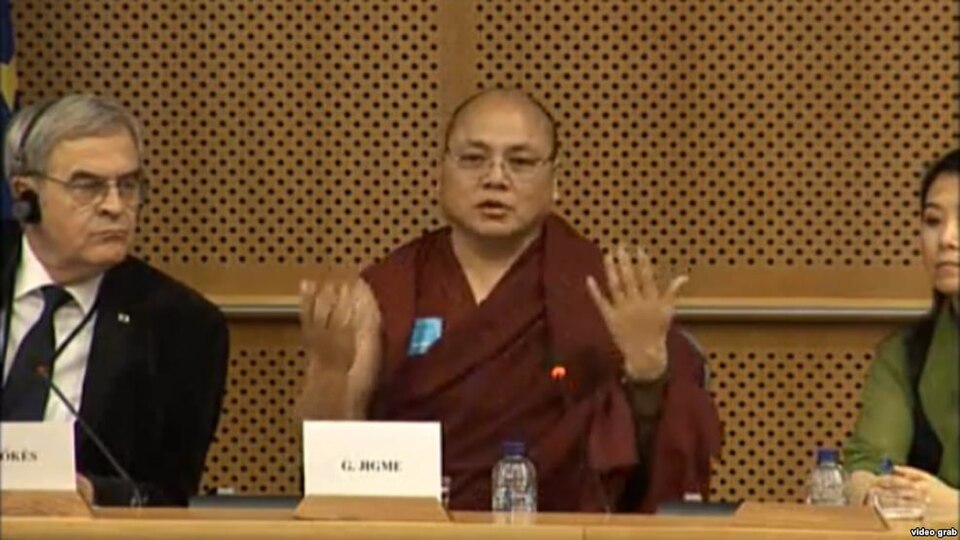
Golok Jigme in 2016 (Voice of America, public domain; image via Wikimedia Commons).
Golok Jigme is a monk of Labrang Monastery in Gansu. From 2007 to 2008, he and Dhondup Wangchen secretly filmed the documentary Leaving Fear Behind, interviewing 108 ordinary Tibetans. After the tapes were smuggled abroad, both men were arrested; Golok Jigme was detained three times, escaped custody in 2012, and was then made the subject of a RMB 200,000 bounty by Gansu police on suspicion of "intentional homicide". After twenty months on the run, he reached Dharamsala, India, in May 2014, and in January 2015 he was granted political asylum in Switzerland. Over the decade since, he has continued to testify on human rights in Tibet at the United Nations, the European Parliament and the US Congress.
Golok Jigme was born in 1969 (one account gives 1972), a native of Serthar, Sichuan, and a monk of Labrang Monastery. From 2007 to 2008, he assisted Dhondup Wangchen in secretly filming Leaving Fear Behind: the two travelled through Tibetan areas, interviewing 108 Tibetans about the Dalai Lama, the Beijing Olympics and the governance of Tibet. The tapes were sent abroad in advance, and the film was released overseas in August 2008, on the eve of the Beijing Olympics.
In March 2008, Golok Jigme was arrested (his own testimony gives March 23; another account gives March 28) and held for about seven months. According to his testimony and accounts, he was subjected to torture including beatings and electric shocks while in custody; he was released in October 2008. Some sources say he was sentenced to seven months, but no judgment has been seen, so this site records only that he was "held for seven months and released with no record of a trial" (Tibet Watch's account is that he was held without charge or trial). Dhondup Wangchen, his co-defendant, was sentenced to six years. In March 2009, Golok Jigme was briefly detained again.
On September 20, 2012, Golok Jigme was taken away for a third time (a document of the UN Working Group on Enforced or Involuntary Disappearances gives September 22). According to his own account, he escaped custody on the night of September 30; the Gansu Provincial Public Security Department then issued a wanted notice saying he was "suspected of intentional homicide" and offering a reward of RMB 200,000 (as recorded by the Central Tibetan Administration and Tibetan human rights organizations). He hid and fled through the mountains and Tibetan communities for about twenty months.
On May 18, 2014, Golok Jigme arrived in Dharamsala, India. In January 2015, he arrived in Switzerland and was granted political asylum (according to the written testimony he submitted to the US Congressional-Executive Commission on China). He was named one of Reporters Without Borders' "100 Information Heroes" in 2014, and in 2018 he and Dhondup Wangchen jointly received the Tenzin Delek Rinpoche Medal of Courage. During his exile, he has testified and spoken at a US Congressional-Executive Commission on China hearing (2016), the European Parliament's Subcommittee on Human Rights, side events of the UN Human Rights Council, and the Geneva Summit for Human Rights and Democracy. On March 26, 2025, a Radio Free Asia report quoted his comments and noted that he now lives in Zurich. On May 29, 2025, he and Dhondup Wangchen jointly wrote to the Kathmandu International Mountain Film Festival (KIMFF), protesting its creation of a "Xizang Panorama" section with an official Chinese background and demanding its cancellation; the joint letter was made public on May 30. No reports of his public activities have been seen in 2026.
Sources: Golok Jigme's written testimony submitted to the US Congressional-Executive Commission on China (2016); Tibet Watch interview with Golok Jigme; Central Tibetan Administration report on his arrest and escape; Border Lens feature on the 2025 joint letter (July 1, 2025); Tibet Express report on the joint letter (May 30, 2025).