Chen Guangcheng: The Blind Barefoot Lawyer Who Escaped House Arrest and Flew to Freedom in 2012
Issue: Freedom of Expression
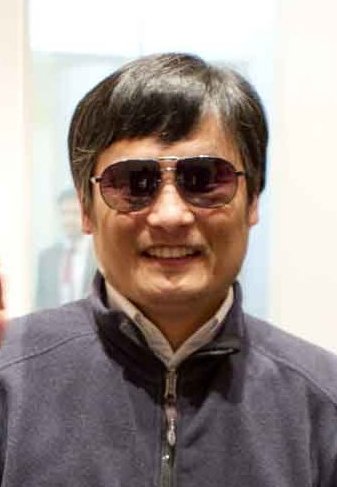
Chen Guangcheng in Beijing with US Ambassador Gary Locke beside him, May 1, 2012. Photo: US Department of State / Wikimedia Commons, public domain.

On May 19, 2012, Chen Guangcheng, a blind rights lawyer from Shandong, boarded a flight from Beijing to New York with his wife Yuan Weijing and their two children. Weeks earlier, the self-taught lawyer had pulled off a near-impossible escape: slipping out of a village home ringed by dozens of guards, he made his way to the US Embassy in Beijing, setting off a diplomatic standoff between China and the United States that lasted for weeks. His escape and departure became one of the most symbolic episodes in China’s rights-defence movement.
Born in 1971 in Dongshigu village, Yinan County, Linyi, Shandong, Chen lost his sight to illness in infancy. He taught himself law and spent years offering free legal help to disabled people and fellow villagers, earning the nickname the “barefoot lawyer.” In 2005 he investigated Linyi’s enforcement of the one-child policy and documented large-scale forced abortions and sterilisations carried out to meet birth quotas, then helped victims file a class-action lawsuit. The revelations drew nationwide attention, and Beijing’s own investigators acknowledged that unlawful coercion had taken place. But for the whistleblower, what followed was not vindication — it was retaliation.
In September 2005 Chen was placed under house arrest. In March 2006 he was “disappeared” for three months, and on August 24, 2006 the Yinan County court sentenced him to four years and three months in prison for “intentionally damaging property” and “gathering a crowd to disrupt traffic.” The trial was widely condemned as grossly unfair, and Amnesty International designated him a prisoner of conscience. Released on September 9, 2010 after serving his full term, he and Yuan were immediately placed under unlawful house arrest in Dongshigu: guards ringed the house, phone and internet lines were cut, and would-be visitors were turned away and beaten. When a secretly filmed video of the family’s life under surveillance reached the outside world in February 2011, the couple were beaten; that December, Hollywood actor Christian Bale was roughed up and driven off by guards when he tried to visit.
On a night in April 2012, Chen climbed over the wall of his home while the guards’ attention wandered. Intimately familiar with every path in his village, he fell repeatedly and broke bones in one foot, but with villagers and activists relaying him onwards he reached Beijing and entered the US Embassy. On May 2, under an initial US-China understanding, he left the embassy for Chaoyang Hospital; reunited there with his family, he said publicly that he feared for their safety and wanted to leave China, and appealed for help by phone to a US congressional hearing. The affair coincided with the US-China Strategic and Economic Dialogue in Beijing and briefly dominated relations between the two governments. After further negotiation, Beijing said Chen could apply to study abroad “through normal channels.” On May 19 the family received US visas and flew to New York, where Chen took up a fellowship at New York University’s law school.
His escape brought reprisals on the family he left behind: in November 2012 his nephew Chen Kegui was sentenced to three years and three months in prison for wounding officials who had broken into his father’s home at night, in what the family described as self-defence; his elder brother Chen Guangfu was also beaten and kept under surveillance. In 2013 Chen took up posts at the Catholic University of America and the Witherspoon Institute, and in 2015 he published his memoir, The Barefoot Lawyer. In August 2020 he addressed the Republican National Convention. On June 21, 2021, Chen Guangcheng became a United States citizen at a naturalisation ceremony in Baltimore. He continues to speak out on human rights in China from the United States.
Sources: Human Rights Watch, Amnesty International, Chinese Human Rights Defenders, and Amnesty International USA.